
The Shift from AI Assistance to Agentic Execution
We Are Already AI-Native
Agents across your SDLC and operations.
This is the evolution from AI-assisted development to agentic delivery:
orchestrated specialist agents for scope, design, implementation, quality, release, and live operations — coordinated like a senior platform team.
Humans retain ownership of outcomes, risk, governance, and compliance.
Book an Agentic Architecture Session
Agent Roles Across the SDLC
- Scope Agent
- Design Agent
- Build Agent
- QA Agent
- Release Agent
- SRE / Ops Agent
This is not “AI as autocomplete.”
These are persistent, reviewable agent workflows wired directly into how software is shipped.
What This Delivers
- 30–50% faster delivery cycles through agent-assisted execution
- 4–8 weeks from idea to MVP using parallel agent streams
- 10+ domains where agent playbooks are already proven
- 100% human-reviewed merges and release gates
From Copilots to an Agentic Operating Model
Inspired by the AI-driven delivery philosophy at Teksolto, this model makes the implicit explicit.
Software delivery is treated as a multi-agent system:
- Clear roles
- Defined checkpoints
- Full observability
- Built-in rollback
Not a single chat window trying to do everything.
Governance Layer
Human Owners, Machine Scale
Product and engineering leaders define the guardrails:
- Security patterns
- Architecture contracts
- Test coverage thresholds
- Deployment and rollback policies
Agents operate only within these boundaries.
Delivery Fabric
Specialists, Not Generalists
Each SDLC stage has purpose-built agent behavior:
- Backlog shaping and scope control
- UX acceleration and design handoff
- Code generation with full repository context
- Test synthesis and coverage expansion
- CI/CD pipeline intelligence
- Post-release signal monitoring
Operations
Agents Do Not Stop at “Merged”
Release and SRE-style agents assist with:
- Canary and progressive delivery checks
- Configuration drift detection
- Incident triage summaries
- Runbook and postmortem drafting
All production actions remain human-approved.
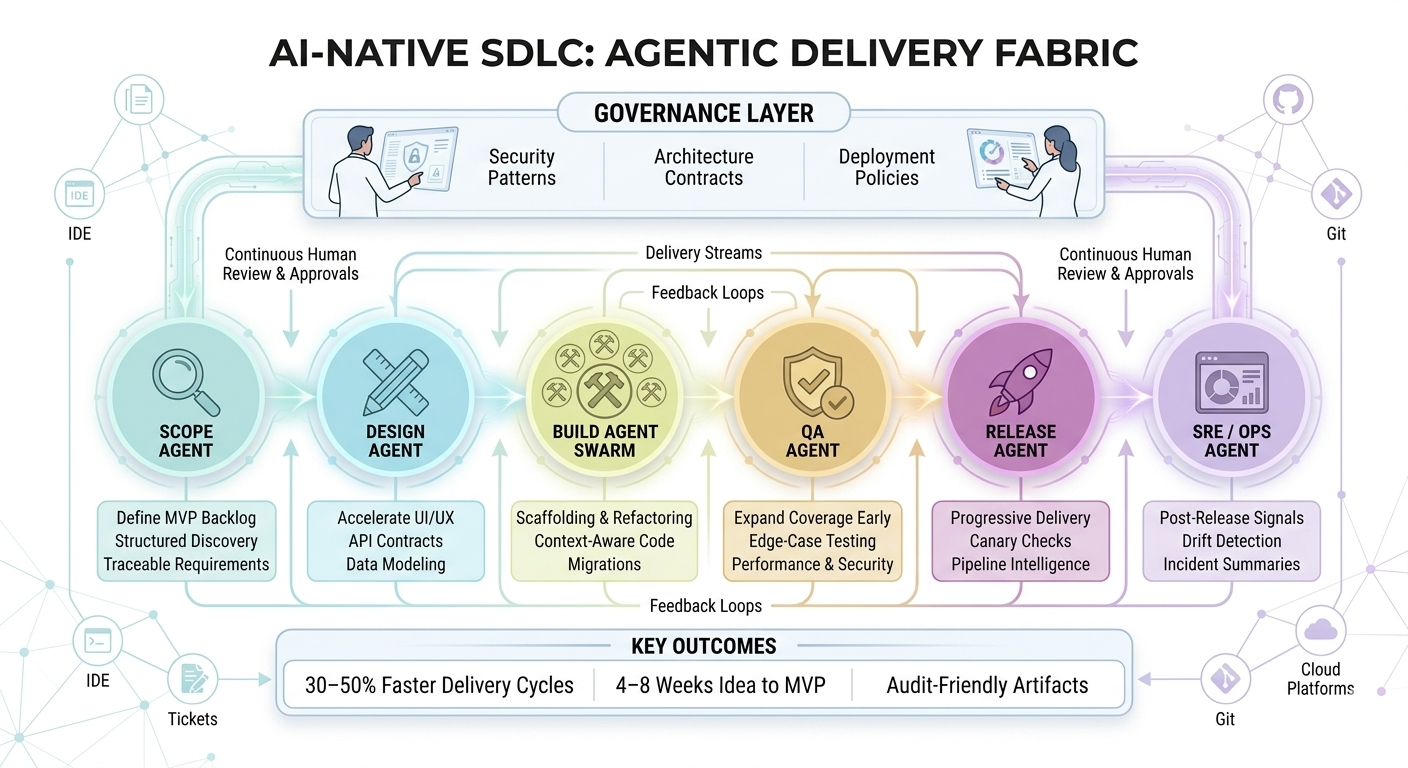
Agent Mesh Across the SDLC
A simplified representation of how work flows between people and agents.
In practice, this maps directly to your existing tools — IDEs, ticketing systems, CI/CD pipelines, and observability platforms.
Stages
- Scope
- Design
- Build
- QA
- Release
- Operations
Human Ownership
- Decision-making
- Risk acceptance
- Final approval
How the Flow Works
01 — Rapid Discovery (Scope Agent)
Clarifies ambiguity through structured discovery:
- Problem framing
- Success metrics
- Impact vs effort analysis
- A frozen, traceable MVP backlog
02 — Design at Velocity (Design Agent)
Accelerates:
- User flows
- Wireframes
- API and data contracts
Engineering never waits on static documents.
03 — Engineering Execution (Build Agent Swarm)
Agents assist with:
- Scaffolding and refactors
- Integrations and migrations
- Context-aware code reviews
- Standards enforcement
04 — Quality by Default (QA Agent)
Expands coverage early:
- Unit, integration, and regression tests
- Edge-case discovery
- Performance and security checks
05 — Ship and Learn (Release + Ops Agents)
Supports:
- CI/CD optimization
- Progressive delivery
- Observability summaries
- Operational narratives for on-call teams
Visual Direction for Production Sites
For final production, use on-brand visuals such as:
- Engineering teams working alongside multi-panel “agent consoles”
- Abstract network meshes showing coordination
- Human-led implementation with agent pair-programming metaphors
- Global delivery visuals (deploy, observe, iterate)
Avoid gimmicks — robots are metaphors, not the product.
Where This Model Is Proven
- SaaS platforms
- AI / ML-enabled systems
- Enterprise modernization programs
- API-first backend architectures
- Integration-heavy platforms
- Data-intensive dashboards
Quick MVP Model — Now Explicitly Agent-Orchestrated
The business promise remains the same:
- 4–8 week delivery
- Startup to enterprise internal tools
What’s different is how it’s delivered:
- Parallel agent streams
- Continuous human review
- Operational readiness from day one
Outcomes
What You Still Get
- Core product features
- Clean, scalable architecture
- API-first backend
- Production-ready codebase
- Deployment and documentation
What Changes
- Transparent agent roles
- Audit-friendly artifacts
- Built-in operational awareness
- No black-box AI bolted onto a waterfall plan
Next Step
Agentic Architecture Workshop
We map your SDLC and toolchain to an agent mesh, identify quick wins (tests, documentation, CI/CD), and define non-negotiable human approval gates.
Book a session and see how agentic delivery fits your engineering reality.