
ERP Migration: From Legacy Architecture to Modern Tech Stack
The Problem Most Businesses Refuse to Talk About
Every enterprise has one.
A system that has been running for a decade, holds the company’s most critical data, and nobody wants to touch — because the last time someone tried to “upgrade” it, things broke for three days and cost more than the original build.
That system is usually the ERP.
ERP platforms built in the early 2000s — and even the early 2010s — were designed for a different era: monolithic codebases, on-premise Oracle or MSSQL databases, tightly coupled modules, and deployment cycles measured in months rather than hours.
They work. Until they don’t.
And the moment a business needs to scale, integrate modern tools, or respond faster than a quarterly release cycle allows, the architecture itself becomes the constraint.
What “ERP Migration” Actually Means
The term ERP migration is often used loosely, but it typically refers to one of three very different approaches:
Lift and shift
Moving the existing system to the cloud with minimal changes. Fast and inexpensive, but rarely delivers anything beyond basic infrastructure cost savings.
Re-platforming
Changing the database or runtime while keeping the core application logic intact. Useful for solving isolated pain points, but it leaves the underlying architectural debt untouched.
Re-architecture
Decomposing the monolith into a modern, maintainable system with the right data model, clear service boundaries, and modern deployment infrastructure.
This is the approach that actually solves the problem.
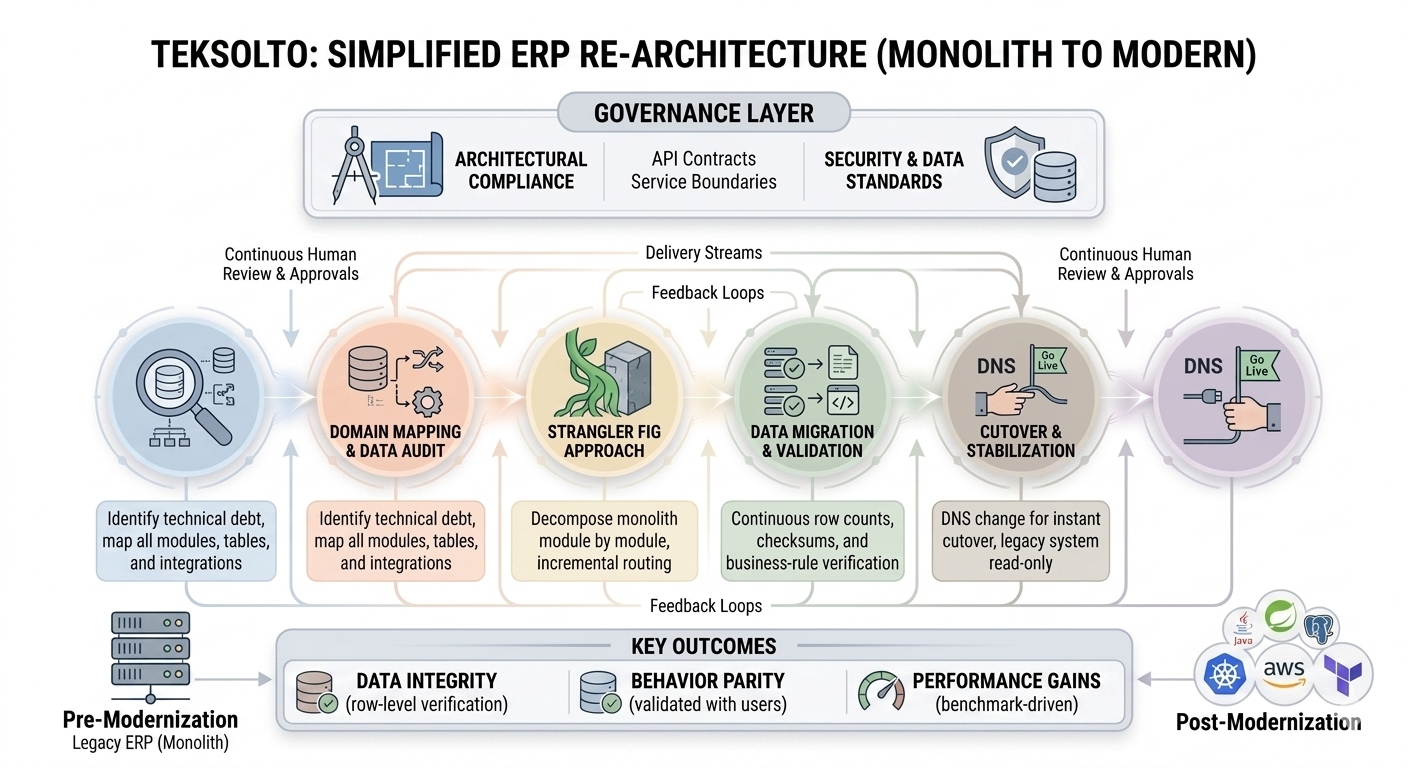
The Teksolto Migration Methodology
Phase 1 — Domain Mapping and Data Audit
Before a single line of new code is written, we map the existing system in detail:
- Every module
- Every table
- Every integration
- Every batch job
This analysis helps identify:
- Which areas are genuinely complex and require careful migration
- Which “features” are actually accumulated technical debt
- Where the data model must be corrected before migration, not after
- Which integrations can move to modern APIs and which must remain unchanged
The outcome is a migration blueprint — a shared source of truth that eliminates surprises and aligns both technical and business stakeholders.
Phase 2 — Strangler Fig Approach
We do not rewrite the ERP from scratch. That approach has a well-documented failure rate.
Instead, we apply the strangler fig pattern:
- New services are built alongside the existing system
- Traffic is routed incrementally
- The monolith is decomposed module by module
This ensures:
- The business continues operating throughout migration
- New features can be delivered on the modern stack immediately
- Each module is validated in production before moving on
- Rollback is always possible — there is no “big-bang” cutover
Phase 3 — Data Migration and Validation
This is the most technically demanding phase.
We run parallel writes to both old and new data stores, continuously validating consistency using automated reconciliation and verification scripts.
For large datasets:
- Historical data is migrated in background batches
- Processing is scheduled during off-peak hours
- Live system performance remains unaffected
Phase 4 — Cutover and Stabilisation
Once all modules are live on the new stack and data integrity is confirmed:
- Cutover becomes a DNS change, not a deployment event
- The legacy system remains available in read-only mode for a defined safety period
The Modern Tech Stack We Migrate To
Backend Services — Java with Spring Boot
For core ERP domains such as finance, inventory, manufacturing, and HR, Java with Spring Boot remains the most defensible choice. Each domain is implemented as an independent service with its own database schema.
Database — PostgreSQL
PostgreSQL replaces Oracle, MSSQL, or MySQL in our migrations due to:
- Full ACID compliance
- Native JSON support
- Strong performance at scale
- No licence cost
For large ERP datasets, table partitioning is implemented from day one.
Infrastructure — AWS with Kubernetes
- Containerised services on ECS or EKS (based on client maturity)
- CI/CD via GitHub Actions or AWS CodePipeline
- Infrastructure as code using Terraform
- Multi-AZ deployment with automated failover
What Accurate ERP Migration Looks Like
A successful migration delivers three outcomes:
Data integrity
Every record from the legacy system exists correctly in the new system. Validation includes row counts, field-level checksums, and business-rule verification — continuously, not just at the end.
Behaviour parity
The new system produces the same outputs for the same inputs. This requires uncovering undocumented edge cases through structured interviews with long-time system users.
Performance improvement
Migration is an opportunity to eliminate slow queries, inefficient batch jobs, and blocking transactions. Every module is benchmarked, and measurable improvements are expected.
Why Faster Does Not Mean Lower Quality
ERP migrations are often assumed to be a trade-off between speed and accuracy. In reality, the longer a migration takes, the more expensive it becomes — in both operational cost and business risk.
Running parallel systems, reconciling data, and maintaining legacy expertise compounds cost every month.
With the right methodology, speed and accuracy reinforce each other. Incremental migration, continuous validation, and module-level cutovers make both possible.
The Expertise Teksolto Has Built
Across ERP migrations in manufacturing, real estate, logistics, and insurance, Teksolto has developed reusable assets that accelerate delivery:
- Domain mapping templates for common ERP modules
- A data migration framework with validation, reconciliation, and rollback
- Standard API contract templates for payroll, accounting, and inventory systems
- A performance benchmarking suite used throughout the migration lifecycle
These assets don’t replace engineering judgement — but they eliminate the need to solve the same problems from scratch on every project.
Is Your ERP Ready to Migrate?
Your architecture is already the constraint if you’re experiencing:
- Feature requests taking quarters due to tight coupling
- Costly middleware for basic integrations
- Performance degradation as data volumes grow
- Dependence on a few individuals who “know the system”
The risk of staying on legacy architecture compounds every year.
The risk of a well-executed migration is bounded, managed, and temporary.
 Talk to the Team
Teksolto’s ERP migration practice can assess your system, produce a clear migration blueprint, and provide a realistic timeline and cost — before you commit.
Book a free 30-minute architecture review →